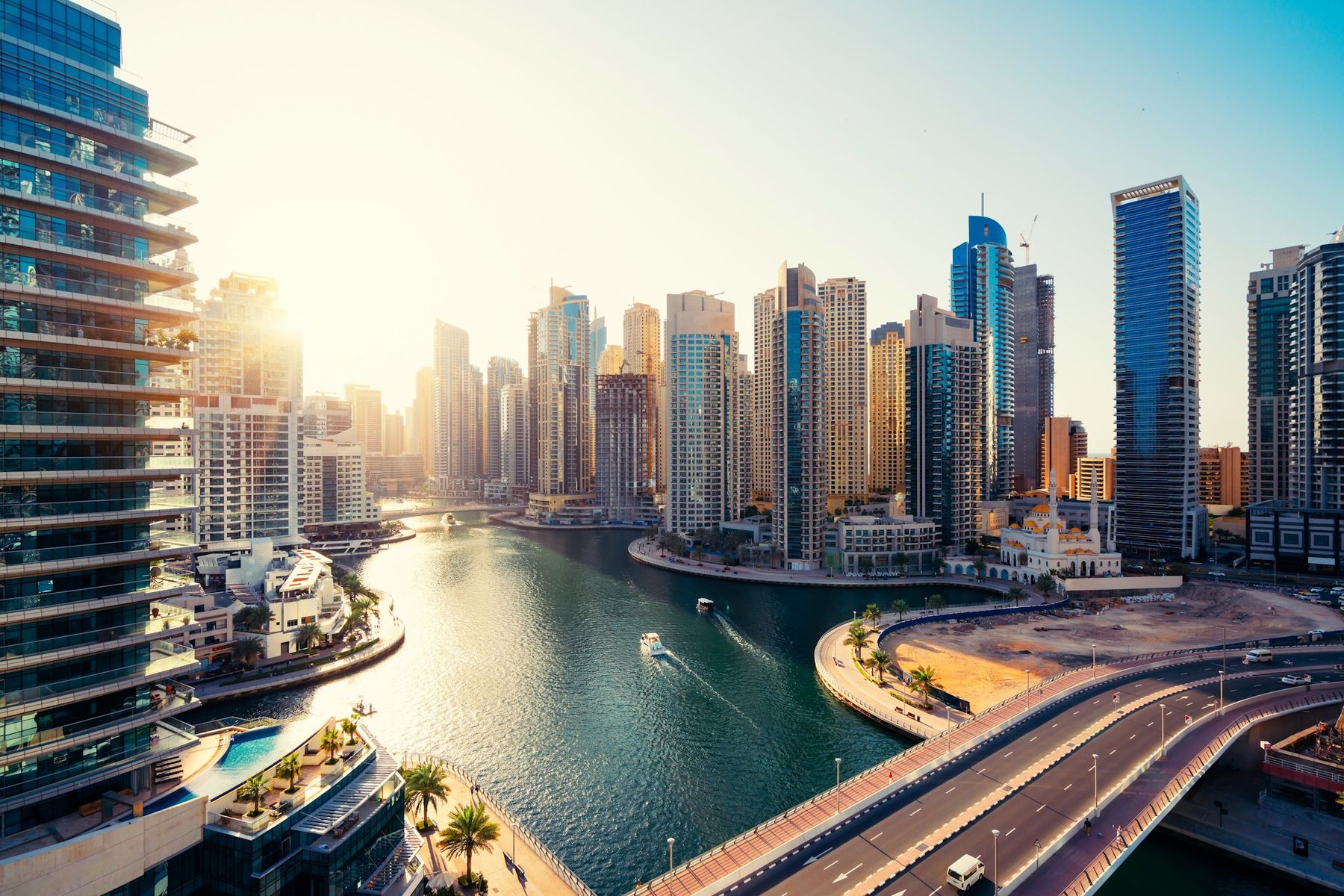
Dubai's property market has had its first genuinely difficult quarter in years. Home sales in the third quarter of 2026 fell 47% by value and 38% by volume compared with a year earlier, according to figures reported by The National, as the Iran war that began in late February made buyers think twice. Yet the Dubai luxury property market tells a different story. Savills data published this week, reported by Emirates 24|7, shows luxury prices still rising year on year, and hundreds of eight-figure deals still being registered.
The gap between the two is the most interesting thing about Dubai right now.
A market that lost its momentum
By Knight Frank's account, the luxury end of the market had broken records for five years running. The conflict changed the pace across the city. The National put third-quarter sales at about 34,000 transactions worth Dh72.6bn ($19.7bn), down from roughly 55,000 a year earlier. Over the first nine months of 2026, volumes were 23% lower and values 27% lower, at Dh292bn.
S&P Global data cited in the same report shows the slowdown began with the war: an average of 12,644 transactions a month between March and September, against 17,198 a month in January and February. Ronan Arthur of Cavendish Maxwell described buyers becoming more measured and cautious in the weeks and months after the fighting started.
Prices have followed. S&P Global Ratings estimated that values fell by between 5% and 15% from the end of 2025 to September, and expects a gradual correction rather than a sudden drop, with apartments likely to weaken more than villas because of the volume of new supply. Even Mohamed Alabbar, the founder of Emaar, has talked of a correction of 5% to 10%. Off-plan homes still dominate, making up 65% of sales by value and 72% of purchases.
Why Dubai luxury property prices are still rising
At the top of the market, the numbers look quite different. According to Savills' third-quarter report:
- Luxury apartment prices rose 4% year on year, to an average of AED5,237 per square foot.
- Luxury villas and townhouses rose 3.6%, to AED2,791 per square foot.
- Deals above AED10m (about $2.7m) numbered 669 in the quarter.
- Rental transactions rose 16% on the previous quarter, to 181,900.
The biggest sales of the quarter were a villa on Palm Jumeirah at AED260m, a villa in Hills View in Dubai Hills Estate at AED252m, and an apartment at Aman Residences at AED166m. Savills also recorded a shift towards ready homes, with the value of completed-property sales rising to AED25.1bn from AED21.3bn. That fits a familiar pattern in uncertain times: wealthy buyers prefer something they can see and move into over a promise of something finished in three years.
Inside the $10m-plus market
The very top end had already set records before the conflict could show up in the data. Knight Frank counted 296 sales above $10m in the first half of 2026, worth $5.1bn. That was 16% more deals than in the first half of 2025, and 49% more than in the same period of 2024. A record 26 homes sold for more than $25m. Dubai Hills Estate led with 51 sales, just ahead of Palm Jumeirah with 50 and Palm Jebel Ali with 40. The most expensive deal was a six-bedroom apartment at Aman Residences in Jumeirah Second for $114.9m (AED422m).
Knight Frank was careful about what those figures meant. Faisal Durrani of Knight Frank pointed out that many of the deals were agreed before the conflict and only registered later, because of the usual four- to six-week delay. His colleague Nicholas Spencer was blunter about the rest of the city, noting "prices ebbing widely across the city's mainstream market".
Later data suggests the top end has slowed but not stalled. An analysis of Dubai Land Department figures by fäm Properties counted 335 sales of $10m-plus homes between January and August, split between 206 villas worth AED11.7bn and 129 apartments worth AED8.67bn. (The two firms count deals differently, so their totals are not directly comparable.) By that measure, the busiest villa area was Hadaeq Sheikh Mohammed Bin Rashid, with 48 deals averaging AED57.8m, followed by Palm Jebel Ali and Palm Jumeirah. For apartments, Jumeirah Second led by value, at an average of almost AED90m per sale. The most expensive villa of the period, a seven-bedroom home at La Mer in Jumeirah First, sold for AED350m.
Sales have slowed, but the people at the top of the market have kept buying, and prices there have not fallen.
The wealth that keeps arriving
Behind all this sits the steady arrival of wealthy people. The Henley Private Wealth Migration Report 2026, published in June, gave the UAE one of the highest scores in the world in its new Wealth Mobility Competitiveness ranking, at 85.3, thanks largely to its tax regime and openness to investors.
The report also picked up some nervousness. Henley recorded a 41% rise in enquiries from UAE residents between the fourth quarter of 2025 and the first quarter of 2026, and a 29% rise in applications for a second residence or citizenship. Its reading is that this is about having a back-up plan, not leaving. Dominic Volek, its group head of private clients, described it as "greater engagement around resilience and contingency planning rather than relocation". The enquiries came mostly from expatriate entrepreneurs and investors who want an option elsewhere while keeping their base in the Gulf.
That fits what the luxury data shows. Wealthy residents are taking out insurance, through a second passport or a home elsewhere, without selling up in Dubai.
What to watch
Three things will decide whether the top of the market keeps holding up while the rest of the city adjusts:
- Registrations from the summer onwards. Because of the lag Knight Frank describes, deals agreed after the conflict started are only now feeding through. The full-year $10m-plus totals will be the first clear test.
- Supply. S&P Global expects apartments to bear the brunt of any correction because of the volume of new homes on the way. Prime villas, which are scarcer, have so far held their value better.
- The region itself. The analysts cited here link the slowdown to the conflict. A lasting calm would probably bring back the cautious mid-market buyers first. A wider escalation would test whether the wealthiest buyers are as committed as they now look.
The takeaway
Dubai is going through its first real correction in years, but the correction is uneven. Mainstream prices are softening and transaction numbers have fallen hard, while luxury prices are still edging up and eight-figure deals are still closing. For developers and brands selling to wealthy buyers in the emirate, the message is that the money hasn't left, but it is choosier. Ready homes, prime locations and scarce villas are what is selling.
Selling to high-net-worth buyers? Talk to High Net Marketing about marketing, PR and features in HNWI.